




Older drainage systems can develop problems slowly, often without obvious warning signs. Knowing what to look for can help you deal with an issue before it becomes a costly repair.
“Did you know? A UK Government report from the Department for Environment, Food and Rural Affairs (DEFRA) estimated that around 50,000 properties in England and Wales still have older pitch fibre drainage systems. Many of these systems were installed decades ago and are now reaching an age where deterioration can become more common.”
This guide explains how pitch fibre drains work, why they can deteriorate, the warning signs to watch for, and the solutions that may be available. The goal is to help you understand your drainage system and decide when professional advice is needed.
Key Takeaways
- Pitch fibre systems are found mainly in older properties.
- The material can deteriorate and change shape over time.
- Deformation can reduce the space available for wastewater.
- Recurring blockages may indicate a structural drainage issue.
- CCTV surveys can reveal hidden problems without immediate excavation.
- Repair, relining, or replacement may be possible.
- The best solution depends on the condition and location of the pipe.
- Early investigation can help prevent repeated drainage problems.
What Are Pitch Fibre Drains?
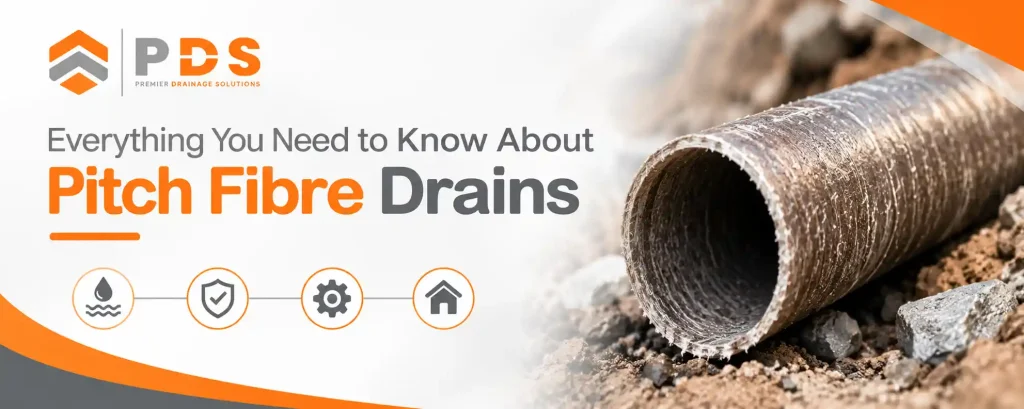
What are pitch fibre drains? They are underground pipes made from wood fibre and bitumen. They became popular because they were lightweight, affordable and easy to install.
Pitch fibre pipes were commonly used for foul and surface water drainage. However, as they age, the material can soften, distort, and become narrower inside, restricting wastewater flow.
Need Help With Pitch Fibre Drains? Contact Our Experts Today!
How Do These Pipes Carry Wastewater?
Think of a drainage pipe as a pathway for wastewater.
Its job is to provide enough internal space for water and waste to move away from the property. When the pipe is in good condition, this process usually happens without much trouble.
1. Normal Wastewater Flow
Wastewater flows through the pipe smoothly, allowing the drainage system to operate properly.
2. Gradual Material Deterioration
Over time, the pipe material may weaken, soften, or gradually change shape.
3. Narrower Internal Passage
As the pipe deforms, its internal space can become increasingly narrow.
4. Restricted Wastewater Flow
A narrower passage allows waste and debris to collect, increasing the risk of blockages.
5. Recurring Drainage Issues
Repeated blockages, slow drainage, and water backups may become increasingly common over time.
Why Can Older Drainage Systems Fail?
There is rarely just one possible cause.
Age is an important factor, but the surrounding conditions and history of the drainage system also matter.
Several things can place additional pressure on older pipework:
- Age: Materials naturally deteriorate over long periods.
- Ground movement: Shifting soil can place pressure on buried pipes.
- Tree roots: Roots can enter through vulnerable areas and affect drainage.
- Heavy loads: Traffic or construction above the pipe can add pressure.
- Repeated blockages: Frequent obstruction can put additional strain on the system.
- Poor installation: Incorrect gradients or connections may cause ongoing problems.
These factors can work together. A pipe that has already weakened with age may be more vulnerable to movement or external pressure.
Signs Your Drainage System May Have a Problem
Not every slow drain means there is a serious structural fault.
However, pitch fibre drain problems often become noticeable through repeated or worsening symptoms.
Watch for these warning signs:
- Toilets take longer to empty
- Sinks drain slowly
- Drains block repeatedly
- Water backs up after flushing
- You notice persistent drainage smells
- Drains make unusual gurgling sounds
- Problems return soon after cleaning
- Wet or unusually soft ground appears near drainage areas
A single blockage may simply be caused by household waste. Repeated problems are more concerning because they may indicate an issue further along the drainage system.
Why Can One Section Cause Bigger Problems?


A drainage system can contain many individual sections. They do not necessarily deteriorate at the same rate.
One section may still be in reasonable condition while another has become badly deformed.
This is why clearing a blockage does not always solve the underlying problem.
If the same drain becomes blocked again and again, the pipe itself may need to be inspected.
A CCTV survey can help identify:
- Internal deformation
- Cracks and damaged areas
- Root intrusion
- Heavy deposits
- Blockages
- Narrowed sections
- Other visible defects
This gives a clearer picture of the actual condition beneath the ground.
How Can You Find Out What Is Wrong?
Instead of immediately digging up the drainage system, start with an inspection.
A CCTV drain survey is one of the most useful ways to investigate an older system. A small camera is guided through accessible pipework and records the condition from inside.
The survey can help answer important questions:
Is there a blockage?
If so, where is it and what is causing it?
Has the pipe changed shape?
Deformation can restrict the space available for wastewater.
Are there damaged sections?
The inspection may identify cracks or other visible defects.
Is the problem local or widespread?
This can help determine whether a small repair or larger work may be needed.
The findings can then be used to decide what should happen next.
Can Pitch Fibre Drains Be Repaired?
In some cases, yes.
The right solution depends on the pipe’s condition. Localised damage may need a simple repair, while severe damage could require replacement.
A professional pitch fibre drain repair should be based on the pipe’s actual condition, not its age alone.
Possible solutions may include:
Situation | Potential approach |
Small localised defect | Local repair |
Damaged but accessible pipe | Section replacement |
Suitable pipe with internal deterioration | Drain relining |
Several severely damaged sections | More extensive replacement |
Collapsed or badly deformed pipe | Excavation and replacement may be required |
The final choice should be made after the drainage condition has been properly assessed.
Could Drain Relining Be Suitable?
Drain relining can sometimes avoid the need for extensive excavation.
The process involves installing a new lining inside the existing pipe. Once cured, the lining forms a new internal surface and can restore the flow path.
Potential benefits include:
- Less excavation
- Reduced disruption to gardens and driveways
- Faster work in suitable situations
- A renewed internal pipe surface
- Potentially longer service life
However, relining is not suitable for every situation.
A severely collapsed or badly deformed pipe may not provide enough space for the lining process. A professional survey should therefore be completed first.
When Should You Consider Pipe Replacement?
Sometimes replacement is the more practical option.
This may be considered when the drainage system has extensive structural deterioration or several sections are affected.
Replacement may be appropriate when:
- The pipe has collapsed.
- Deformation is severe.
- Several sections are badly damaged.
- The existing pipe cannot support a suitable lining.
- Recurring faults continue despite previous repairs.
Replacement can involve excavation, so it may cause more disruption than a trenchless solution.
However, a complete replacement can provide a fresh drainage system and may make more sense when the existing pipework is beyond reliable repair.
What Can You Do to Protect Older Drainage?
You cannot prevent an ageing pipe from deteriorating forever, but good habits can reduce avoidable blockages.
- Watch what goes down the drain
Avoid sending fats, oils and unsuitable waste into sinks. - Flush responsibly
Only flush materials suitable for the toilet. - Act on slow drainage
Do not wait until a slow drain becomes completely blocked. - Monitor recurring issues
Keep track of how often problems return. - Arrange an inspection when needed
Older systems with repeated faults may benefit from a CCTV survey.
Small changes can reduce unnecessary blockages and help you spot changes in performance earlier.
What Should You Do When Problems Keep Returning?
Repeated drainage faults should not simply be treated as separate incidents.
If a drain keeps blocking after cleaning or jetting, consider investigating the cause rather than repeatedly clearing the symptom.
A sensible process is:
Notice the problem → Record the symptoms → Arrange a CCTV inspection → Review the findings → Choose the appropriate repair or replacement option.
This approach can prevent unnecessary work and give you a clearer idea of what is happening underground.
Precise Drainage Solutions can help assess drainage issues and identify a practical solution based on the condition of the existing system.
Get Your Drainage System Checked Before Problems Escalate
Older drainage systems can deteriorate gradually, causing slow drainage, recurring blockages and unpleasant smells.
Understanding what pitch fibre drains are and recognising these warning signs can help you act early. A professional CCTV survey can identify hidden damage and help determine the right solution.
If you are concerned about ageing pitch fibre drains or recurring drainage problems, contact us today for professional advice and reliable drainage solutions.
Frequently Asked Questions
1. How old are pitch fibre drainage systems?
Many were installed several decades ago, particularly during the mid-20th century. Their current condition depends on installation quality, ground conditions, usage, and long-term deterioration.
2. What are pitch fibre pipes made from?
They are generally made using wood fibre combined with bitumen. This creates a lightweight pipe material that was widely used for underground drainage in the past.
3. What are pitch fibre pipe problems usually caused by?
Age-related deterioration is a major factor. Deformation, restricted flow, roots, ground movement, and repeated blockages can also contribute to problems.
4. Can old drainage pipes be relined?
Some can. Relining depends on the condition, shape, and accessibility of the existing pipe. Severely collapsed or badly deformed sections may need another solution.
5. Should an old drainage system always be replaced?
No. An older system does not automatically need replacement. A CCTV inspection can help establish its actual condition and whether repair, relining, or replacement is appropriate.